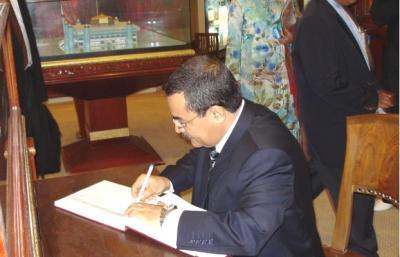
Almotamar.net - The Yemeni ambassador to Malaysia Abdullah Mohammed al-Mutasir on Wednesday discussed with Prime Minister of Malaysian Malka region Mohammed Ali Rustom the ways of cooperation in the field preserving the historical cities in the two countries in addition to exchange of visits by officials concerned with preservation of historical cities in the manner preserving their architectural and historical stamp as considered part of the human civilization and culture.
In the 10th world symposium on twinning the city of Malka attended by 30 foreign countries, the Yemeni ambassador talked on the historical relations of Yemen with Malaysia in general, saying the city of Malka was the first stop of pioneer Yemenis when they came to it carrying the message of Islam.
He added that the significant location of Malka
Made it a civilization and commercial city where the Yemeni civilization and the Islamic culture had blended via Yemeni merchants trips and they played an important role on the formation of the civilization and culture in the region.
On the other hand the Yemeni ambassador to Malaysia the Malaysian Naval Academy in Malka and met the director of the Academy and got informed on programmes of qualification and training of the Yemeni students there and their studying level in different naval specialties and sciences.
The United Arab Emirates acknowledged on Tuesday that two of its pilots were killed when their military aggression plane crashed over Jawf province, a military official said
The official added that the aggressive crashed plane was an apache that was
Artillery of the army and popular shelled a gathering of Saudi-paid mercenaries in al-Moqadra area in Serwah district of Marib province, a military official said on Tuesday.
Meanwhile, dozens of Saudi-paid mercenaries were killed and others injured in Wadi al-Theek in the district, the official added.
The army and popular forces carried out on Monday unique military operations in Taiz province.
A military official said that a number of Saudi-paid mercenaries were killed at the hands of the army and popular forces in al-Jazami Hill in al-Kadaha area in al-Ma'afer district.
A Saudi aggression fighter jet targeted a citizen's car driving in Fara area of Kutaf district in Saada province overnight, killing the driver and injuring his friend, a security official said on Monday.
The army artillery and popular committees launched a fierce attack on Saudi-paid mercenaries' sites in Jawf province, a military official said on Monday.
The attack destroyed a military vehicle belonging to the mercenaries and killed all on board in Sabran area in khab and shaaf district.
Scores of Saudi enemy soldiers were killed and injured on Sunday when the army and popular forces repelled a Saudi military attempt to sneak into Shurfah site in the border province of Najran, a military official said.
The operation was accomplished successfully against the Saudi
The army and popular committees have killed a total of 18 Saudi-paid mercenaries in sniper operations over the past hours in the central province of Marib, a military official said on Sunday.
Ten mercenaries were killed in Nehm district and eight others were killed in Serwah district, said the official.
Saudi aggression warplanes have launched more than 49 airstrikes over the past hours on several residential areas across Yemen, a security official said on Sunday.
The airstrikes targeted the areas of Malahiz and Husama in Dhahir district, and areas Thuban, Masahif and Sdad in Bakim district of northern Saada province.


 Yemen attends 10th symposium on twinning Malaysian city of Malka



